
THE ROBOTS THAT SEEK OUT THE RADIOACTIVE SECRETS OF THE SEAS
Autonomous underwater vehicles are learning to detect marine radioactivity in real time. The European RAMONES project shows how AI and innovative sensors could transform how we monitor oceans for underwater hazards and disasters.

Beneath the sparkling sea of the Mediterranean near the island of Santorini, a quiet revolution in ocean science has been unfolding. It centres on a squadron of autonomous marine gliders programmed to think for themselves, dive deep below the waves, and detect the faintest whispers of radioactivity.
“Our objective was to measure radioactivity in the marine environment in situ and in real-time – something that had not been done before,”
says RAMONES project coordinator Theo J. Mertzimekis, an Associate Professor of Nuclear Physics at the National and Kapodistrian University of Athens.
Theo describes RAMONES not as a conventional research programme, but as a bold experiment in possibility. “We wanted to provide very innovative solutions in the marine environment by investing in technologies that only very recently became available,” he explains.
The project combined cutting-edge robotics, AI and bespoke radiation sensors to create a new way of monitoring radioactivity beneath the sea. At stake, better ways to find and track industrial waste and environmental hazards, explore how nutrients work their way around the globe, and even investigate the sites of known or unknown deep-sea nuclear accidents – past and future.
Deep detection
The challenge of measuring radioactivity underwater is not trivial. A more immediate question might be why measure it at all, given the immense practical difficulties. Radioactivity in the marine environment on the seafloor has been present since the Earth’s formation, providing clues for investigating the fundamental geochemical processes by which our world was formed, and how tectonic plates have moved, for example.
And it’s not until radioactivity is measured that scientists can understand oceanographic processes, such as water-mass transport, sedimentation rates and carbon cycling using isotopes as tracers.
Then there is nuclear safety. In-situ monitoring can provide immediate data around underwater waste storage sites or during disasters, like the Fukushima incident, to instantly inform decision making on emergency response plans. The decommissioning of the growing number of old and now unused nuclear submarines is another area where sensitive detection around boatyards can save human health, and safeguard help the environment.
But radiation detectors on land can be large and power-hungry: scaling them down for underwater use where communication is typically slower and energy more limited forced the team to innovate.
“This was a pathfinder project: high risk, high gain,” says Theo. “From the beginning, we knew that some things might not work as planned.” And indeed, some failures happened. One instrument was lost at sea, claimed by the very environment RAMONES hoped to understand. But far from being a setback, it became part of the project’s learning curve. “This is the sea, things happen. Failure is a big school. You stop, take a breath and then you go again,” he says.
In pushing technology into areas it had never been in before, the team accepted that some risks would not pay off. The RAMONES project was supported by a €4 million European Innovation Community (EIC) Pathfinder grant, the type designed for breakthrough deep tech programmes with significant technological ambition, but a risk profile to match.
Several prototypes achieved impressive performance levels, with one reaching a technology readiness level (TRL) of seven – the demonstration of a system prototype in an operational environment.
A key innovation was the way the ‘gliders’ – uncrewed underwater vehicles – operated as a swarm-like team. Instead of pre-programmed routes, they could respond to data in real-time, weaving through the water independent of human intervention. “The vehicles could decide by themselves where to go, based on the signals they were receiving,” Theo explains. This gave them the ability not only to survey large swaths of the ocean but to focus on regions of interest and dynamically refine their search.
A Multidisciplinary Odyssey
RAMONES oceanographers collaborated with nuclear physicists, and AI specialists collaborated with marine engineers – all united by a shared belief that the ocean’s depths still hold secrets vital to understanding our planet. That combination was necessary because the challenge was so complex: creating robotic systems capable of autonomous decision-making, equipping them with new types of radiation detection technology, and then deploying them into unforgiving, dynamic marine environments where unpredictable weather and rough seas rule. “It was a truly multidisciplinary effort – robotics, artificial intelligence, new sensors, oceanography – all had to work together,” says Theo.
One of the project’s most intriguing test sites was off the coast of Santorini, where an underwater volcanic system churns out geothermal energy and natural radioactivity. “We realised we had a natural laboratory beneath us, almost completely unexplored,” says Theo.
In these extreme environments, the gliders’ sensors were pushed to their limits, but detected subtle shifts in natural radioactivity that reveal dynamic geological processes.
Theo says creating systems that can detect and report anomalous radiation levels in real time can be further developed for environmental monitoring and public safety. “This information can be transmitted to civil protection agencies so they can have an early warning if something happens,” he says.
Beyond the Horizon
The willingness to explore uncharted technological territory is woven into every part of the RAMONES project story – from early design meetings during the Covid-19 pandemic to field tests in the unpredictable waters of the Aegean, as well as the Canary and Azores island archipelagos.
The project ended in December 2025, and already the team is looking ahead. Not every goal was met, but the project’s achievements have sparked new ideas and paved the way for future funding and follow-on missions.
“Not everything worked, but overall we exceeded our original scientific and personal expectations,” reflects Theo. “If you want to push the frontier, you need to give scientists the space and security to pursue crazy ideas.” It’s a sentiment that resonates with anyone who has ever watched their brand-new robot sink silently into the deep, carrying the hopes of an ambitious science experiment.
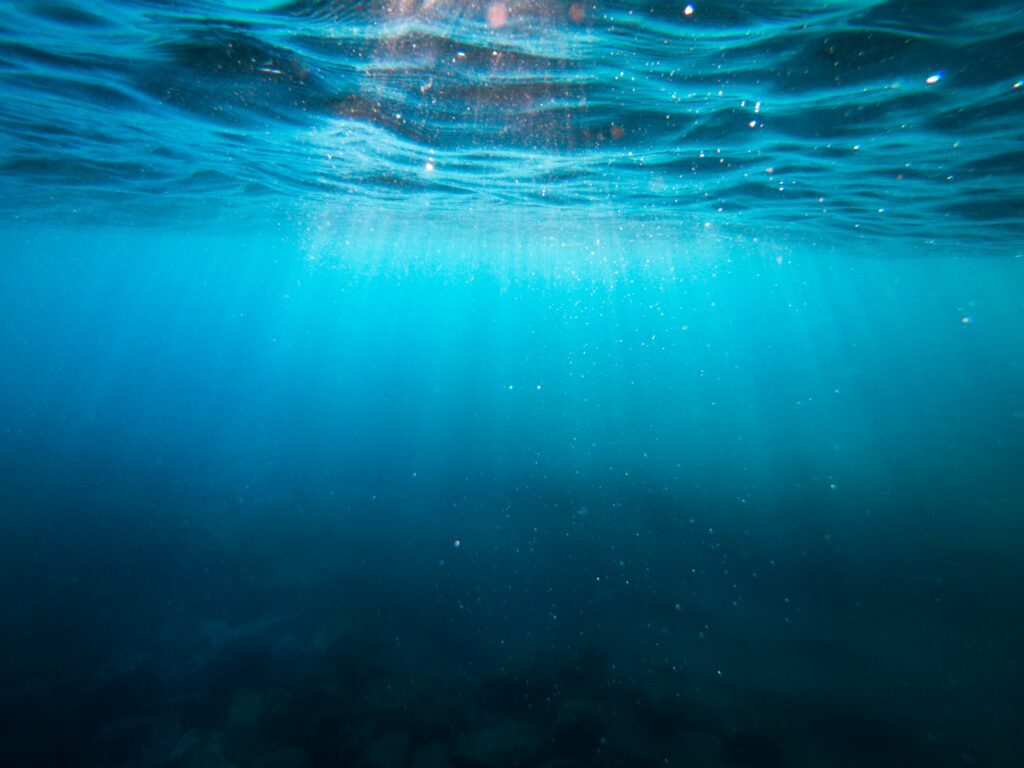
Photo by Cristian Palmer on Unsplash
