

THE BUBBLE THAT DIDN’T BURST: FINDING NANOTECH INSPIRATION IN SOAP FILMS
The story of PROGENY does not begin in a lab surrounded by advanced equipment, but with a young researcher questioning whether to leave science altogether.
Indraneel Sen, a mechanical engineer from India, had followed a demanding path through industry and academia. After working as an executive engineer, he moved to the United States for a PhD in materials science. He later worked as a postdoctoral researcher on a United States Department of Homeland Security funded (Academic Research Initiative) project. By every conventional measure, he was on track for a career in research. Yet, after years abroad, he returned to India restless and uncertain, disillusioned by both the professional and social environments he had experienced. At one point, he even contemplated abandoning research entirely for something very different. “I was seriously thinking of becoming a monk,” he recalled. “I had to decide whether to walk away from research or give it one last try.”
That turning point came almost by chance. A Romanian acquaintance, connected through family friends, heard him speaking about his ideas and suggested Europe as a new professional destination. The European Union’s funding programmes, she explained, might allow him to pursue the bold and unconventional ideas he had in mind. With little left to lose, Indraneel decided to apply, and that simple step changed everything.
Arriving in Europe, however, Indraneel faced other challenges. Bureaucratic delays frustrated his attempts to initiate independent research, and his first major funding application was rejected.
“Writing an interdisciplinary, international proposal is no joke,” he said. “It was incredibly hard, especially for someone like me, a postdoc without much of a support system and no network.”
Yet the setback gave him something else: it taught him how to organise a consortium and gave him the experience he would need to succeed later.
The idea behind the project grew from a simple but radical question: how can we make electronics that do not poison the earth once we throw them away? Every year, millions of phones, screens, and devices are discarded, their toxic materials leaching into soil and water. Indraneel wanted to imagine devices that worked differently, designed from the beginning to be part of nature, not apart from it. He found himself thinking about the most sustainable material known to humankind: living matter. At the heart of all living systems lies water, endlessly recycled through natural processes. Modern devices, by contrast, are rigid and incompatible with the natural world. What if, he wondered, water-based systems could form the basis for sustainable electronics?
Soap films and bubbles became his unlikely inspiration. Delicate yet structured, these nanoscale membranes are mostly water, and they self-assemble in ways that fascinated scientists from Newton to Leonardo da Vinci. Indraneel imagined that with the tools of modern chemistry, such fragile forms could become functional building blocks for devices. The vision was to design sustainable protonic materials capable of hosting living cells, paving the way for revolutionary biomimetic devices and sensor systems that could perform like nature itself while avoiding the environmental cost of current electronics. “They look so weak,” he said, “but inside them are structures that could change how we think about materials.”
For this dream to take shape, he needed partners. Building the PROGENY consortium became, in his words, “an adventure.” Doors closed at first, though a few encouraging voices urged him to keep trying. One introduction eventually led him to Professor Karl Leo (later becoming PROGENY project coordinator), a pioneer whose inventions had already transformed the screens we use every day. Meeting him seemed impossible. For Indraneel, that was a difficult period, struggling with many things and facing deep uncertainty about his future. Organising the trip to meet him was almost impossible. And yet, he experienced an act of kindness that opened the door. For two days on the island of Mallorca, the two men talked, argued, and sketched ideas. By the end, PROGENY had begun to take form. Soon, more partners joined: from Germany, with Technische Universität Dresden, the Universität Bremen, and Constructor University Bremen gGmb; from France, with the Centre National de la Recherche Scientifique, the Institut Charles Gerhardt Montpellier; from Sweden, with Chalmers Tekniska Hoegskola AB; from Romania, with the Institut National de Cercetare Dezvoltare Pentru Ecologie; from the Netherlands, with Universiteit Leiden; and from Bulgaria, with Wasabi Innovation.
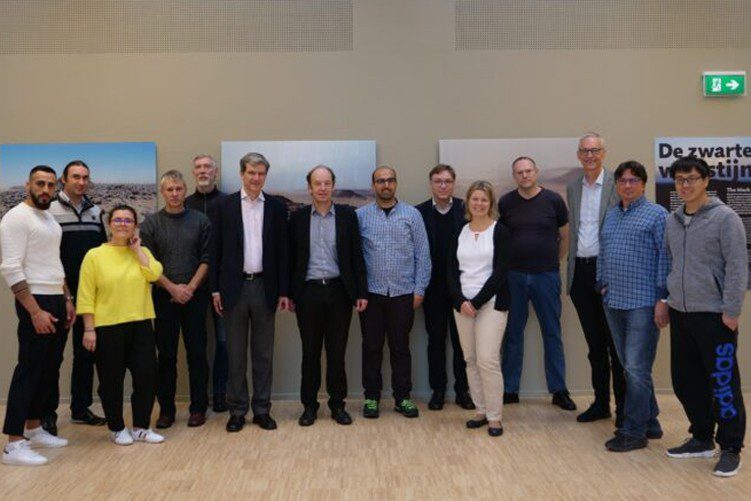
Funding arrived in 2019. But just as the work began, the world shut down. Indraneel was living in northern Italy, a short drive from the epicentre of Europe’s first COVID-19 outbreak. Sirens echoed through empty streets. For nearly a year, he was confined indoors, his project slowed, his family life strained. “Those were the hardest years of my life,” he says. “There were moments when I lost all motivation. I wasn’t persevering, I was just surviving.”
Alongside the pandemic came other challenges: cultural differences, bureaucratic hurdles, and the weight of personal sacrifice. And yet, even in the stillness of lockdown, discoveries were made. The team’s original dream, to create water-based films carrying both electronic and protonic signals, proved out of reach. But in the process, they discovered something unexpected: new fibre-based structures embedded in soap films that produced nonlinear signals in response to infrasound. This breakthrough suggested applications in aviation, environmental monitoring, and even health, where a single sensor could do the work of many. “To achieve this kind of output normally requires a network of sensors,” Indraneel explained. “But we realised a single one could replicate it. That was the innovation we hadn’t foreseen.”
Looking back, Indraneel sees PROGENY as more than a scientific project. It is proof that it is possible to build something out of fragility. There were times when the weight of rejection, cultural distance, and personal sacrifice almost broke him. But he held on to the thought of what this work could mean for the future. “Ultimately, I reminded myself that I was doing this for the next generation. It’s for my daughter and her generation that I want to contribute something meaningful.”
The journey of PROGENY shows how easily a fragile beginning can grow into something lasting. From the delicate shimmer of a soap bubble came the idea for a new kind of device. From the doubts of one man came a project with the potential to reshape how we think about technology. “Life takes you down, and then it lifts you,” Indraneel reflects. “What kept me going was the belief that this work could make a difference, not just for me, but for the generations to come.”
Cover photo by Marc Sendra Martorell on Unsplash
