

REDEFINING THERMAL ENERGY: THE MUSPELL JOURNEY TOWARDS SUSTAINABILITY
Innovative projects often originate with challenges that seem impossible to overcome. For Vlad Iorgulescu, that problem was heat.
With a background in architecture and industrial design, Vlad initially joined Swisspod – a Swiss company developing Hyperloop technology – in 2019 to work on the industrial design side. Hovewer, since life doesn’t always go as planned, he soon encountered firsthand one of the biggest challenges in high-speed transportation: managing heat in an airtight, low-pressure tube. “The system generates heat, and there was no existing solution that met our needs,” he explains. “We had to start from scratch.” That challenge sparked the birth of MUSPELL, a project aimed at developing an advanced thermal energy storage system. But turning an idea into reality is never a straightforward journey.
“It wasn’t easy. We had to build the right team from the ground up.”
The idea of the project began nearly two years ago with a simple but crucial realisation, to further develop the existing thermal management solutions. Hyperloop is a high-speed train that operates in a low-pressure tube to eliminate air resistance and friction, making it significantly more efficient than traditional transport systems. However, to make the system truly viable, Swisspod needed a fresh approach – one that extended beyond their team’s existing expertise. “We started looking for research institutes that could complement our skills,” Vlad recalls. “It wasn’t easy. We had to build the right team from the ground up.”
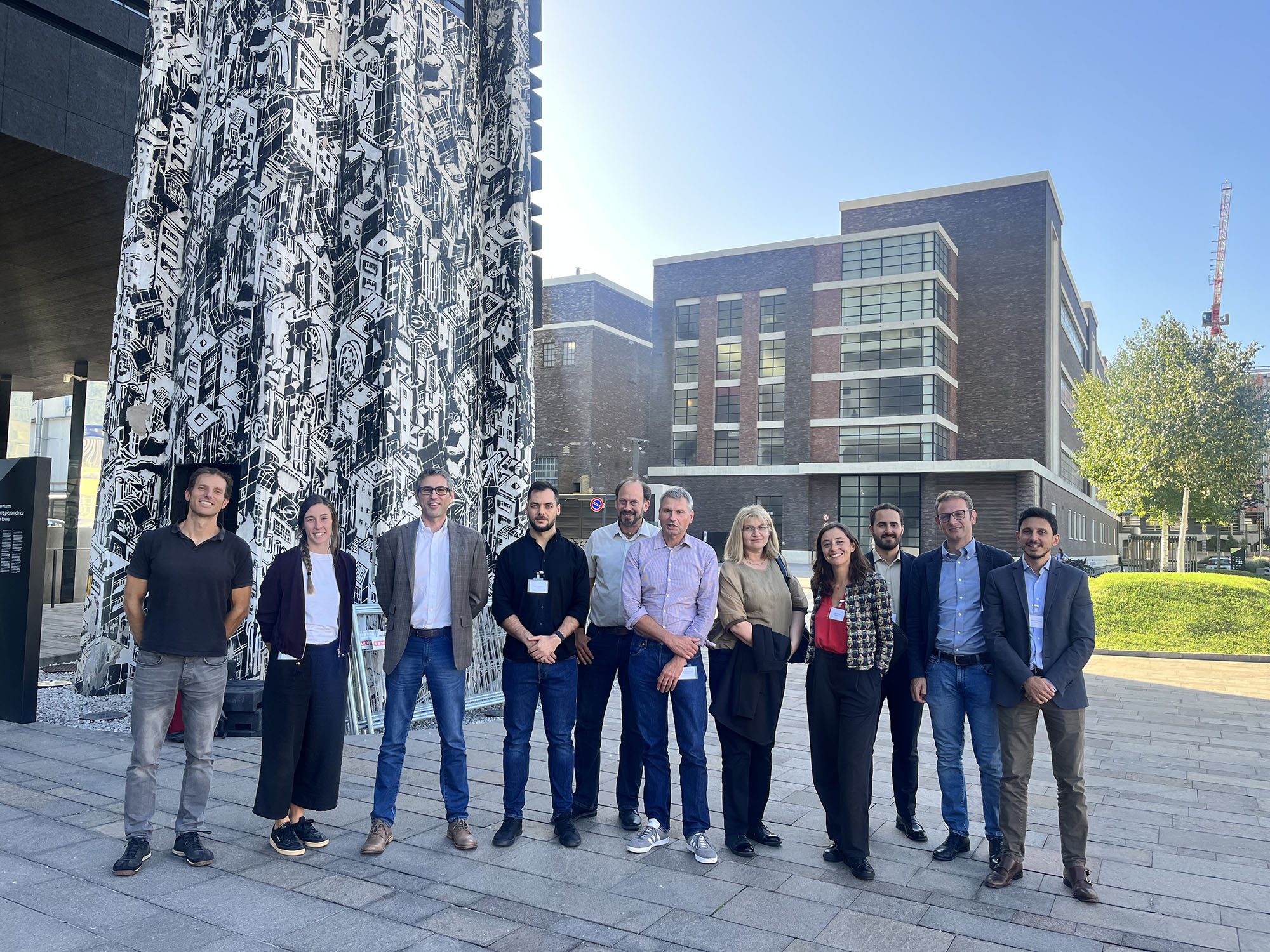
Through persistent networking, they eventually assembled an international consortium of research partners, including Eurac Research (Italy), Fraunhofer Institute for Solar Energy Systems (Germany), Kemijski Inštitut (Slovenia), Universitat Politècnica de Catalunya (Spain), Polytechnic University of Milan (Italy), and Swisspod Technologies (Switzerland).
The next step was finding the right coordinator, which proved to be one of the biggest hurdles. “It’s a lot of responsibility” Vlad admits. “But Eurac stepped up – not only to coordinate but also to help integrate our system into different industries.” A long period of calls, meetings, and brainstorming sessions followed, during which they worked to align their vision and approach.
Once the team was in place, then the funding challenge emerged. “We knew we needed grants, but it wasn’t as simple as picking one and applying,” Vlad says. “We looked at multiple opportunities, not knowing which would be the right fit.” The step forward came when they discovered the Pathfinder Challenge Grant, which specifically addressed thermal energy storage. However, they quickly realised they could not design or develop a solution exclusively for Hyperloop. “No grant would fund something that specific,” Vlad says. “But beyond that, we needed to diversify our portfolio and de-risk the technology”.
“It was an incredible moment, it showed us that all our work had been worth it.”
Eventually, they became convinced it was a perfect match, although, with a success rate of just 6%, the odds were against them. “We worked thirteen-hour days leading up to the deadline,” Vlad recalls. “We had to bring together different fields of engineering into one cohesive application. It was exhausting, but we believed in the idea.” Months later, the verdict arrived and they had won the grant. “It was an incredible moment,” Vlad says. “It showed us that all our work had been worth it.”
Building and coordinating an international team, securing funding, and developing cutting-edge technology all came along with their own set of difficulties. “It wasn’t a straightforward, planned strategy where we knew exactly what would work,” Vlad admits. “We tried different approaches, had countless brainstorming sessions, and worked through problems one by one.” But what kept the team going was their commitment to the idea itself. “We weren’t building this team and project just to get the grant,” Vlad says. “If we had missed this one, we would have found another opportunity. The goal was always to develop this technology.”
Looking ahead, MUSPELL has both short and long-term ambitions. The final goal is to integrate this system into the Hyperloop project and product, making high-speed transport more efficient and sustainable. But along the way, thinking about the medium term, the technology could find applications in other industries like textiles, pulp and paper production, and industrial heating. “We’re merging multiple functions into one system that costs less and has a smaller carbon footprint,” Vlad explains. “If we do this right, we can positively impact the energy sector far beyond Hyperloop. What we’re essentially doing is, combining several functionalities that are currently satisfied by different products into a single solution, that could be more cost-effective and environmentally friendly. I am confident that in doing so, we can make a significant, positive impact on the energy sector for several industries.”
“I work with incredibly smart engineers and scientists, and keeping up with all the technical aspects is tough. […] It’s not a burden – I love learning. And at the end of the day, seeing this idea come to life makes it all worth it.”
For Vlad, the project has been both a professional and personal challenge. Constantly moving between Switzerland and Romania, navigating multiple fields of expertise, and keeping a diverse team aligned have tested his limits. “I work with incredibly smart engineers and scientists, and keeping up with all the technical aspects is tough,” he says. “At the same time, I have to think about market viability, economic impact, and long-term adoption. It’s a lot to balance.” But for someone as naturally curious as Vlad, the challenge is also the reward. “It’s not a burden – I love learning. And at the end of the day, seeing this idea come to life makes it all worth it.”
MUSPELL is more than just a research project. It’s proof that bold ideas, the right people, and sheer belief in the vision can lead to real innovation. For aspiring entrepreneurs and engineers, Vlad’s story offers a simple but powerful lesson: no challenge is too big if you’re willing to tackle it head-on.
