

MEASURING THE INVISIBLE: HOW A SENSOR STUCK IN THE LAB FOUND ITS WAY INTO THE REAL WORLD
“Measure what can be measured,” said Galileo around the start of the 1600s; a masterful aphorism that summarises the metrics of modern life, from weather reports to healthcare stats and economic outlooks. We live in a world of measures. There’s a second, even more enlightened, half to the statement: “……
“Measure what can be measured,” said Galileo around the start of the 1600s; a masterful aphorism that summarises the metrics of modern life, from weather reports to healthcare stats and economic outlooks. We live in a world of measures.
There’s a second, even more enlightened, half to the statement: “… and make measurable what is not so.” And that’s the challenge faced by researchers in labs around the world, you can’t solve a problem until you can see it, quantify it, and then work out ways to change the numbers for human good.
Micro- and nanoplastics are a good example. Who knew 10 years ago that our bodies and ecosystems are being swamped with tiny shards of polymers? And the clouds of potentially harmful nanopollution in the air around us? The trouble with nanoparticles is that they are so small as to be invisible to even the latest modern detection tools. Hidden killers are probably swirling all around our air and water each and every day – but we just can’t see them.
Plenty of particle detectors work nicely in the stable and pristine world of a well-funded European laboratory, only to fail in the harsh realities of the field. A nanomechanical sensor developed at the Technical University of Vienna (TU Wien) could detect single molecules by nanomechanical photothermal sensing, but only under ideal conditions, and only in expert hands.
Today, that same core technology is being used for low-cost field deployment for the study of atmospheric aerosol chemical composition in urban environments as well as polar regions, delivering critical insights with significantly lower cost and simpler logistics compared to conventional studies using aircrafts and complex instrumentation. “We can now measure in 45 minutes what used to take days,” says chemist Josiane P. Lafleur. “And get atmospheric aerosol information where observational data is scarce.”
Born from the European Innovation Council (EIC) funded NEMILIES project led by Josiane, the journey is a familiar story in deep tech: brilliant science, hard lessons, and the long road from proof-of-concept to practical impact, catalysed by the well-designed funding mechanisms.
From Lab Curiosity to Climate Tool
The beating heart of the NEMILIES project is using light – a nanoelectromechanical, not optical – detector working in the mid-to-far infra-red part of the spectrum. The NEMILIES acronym stands for NanoElectroMechanical Infrared Light for Industrial and Environmental Sensing. (The acronym recognises French physicist Emilie du Châtelet, who first predicted the existence of infrared radiation.)
The team first developed the system during the 2019–2021 Nanoelectromechanical Infrared Detector (NIRD) project that successfully fielded a high-sensitivity uncooled detector that could sense mid-to-far radiation at room temperature. This part of the spectrum, in the terahertz band, required expensive and cumbersome liquid helium cooling units to achieve high sensitivity. Josiane’s team cracked that problem using highly sensitive nanomechanical resonators as detectors, but it just revealed another challenge.
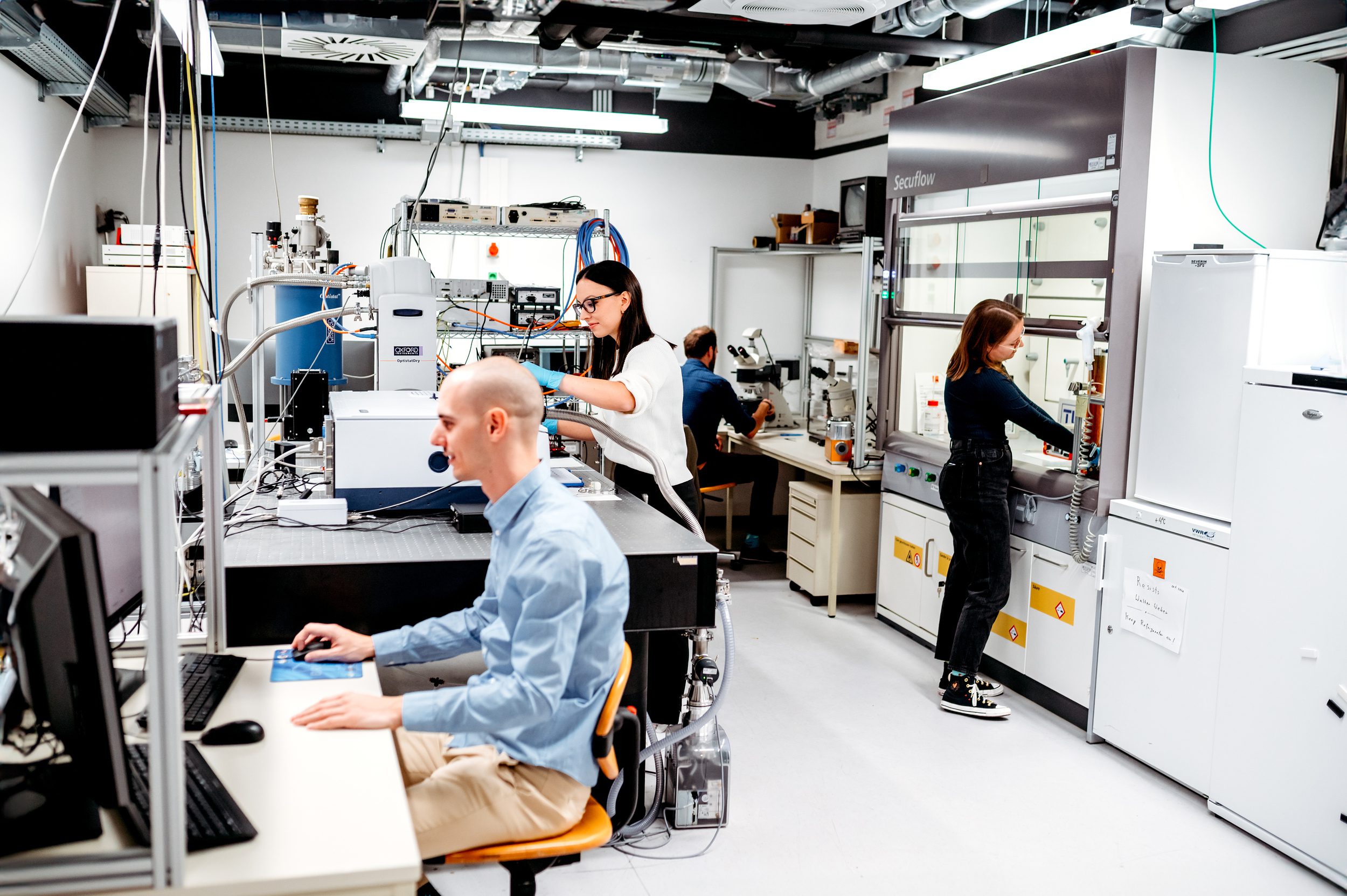
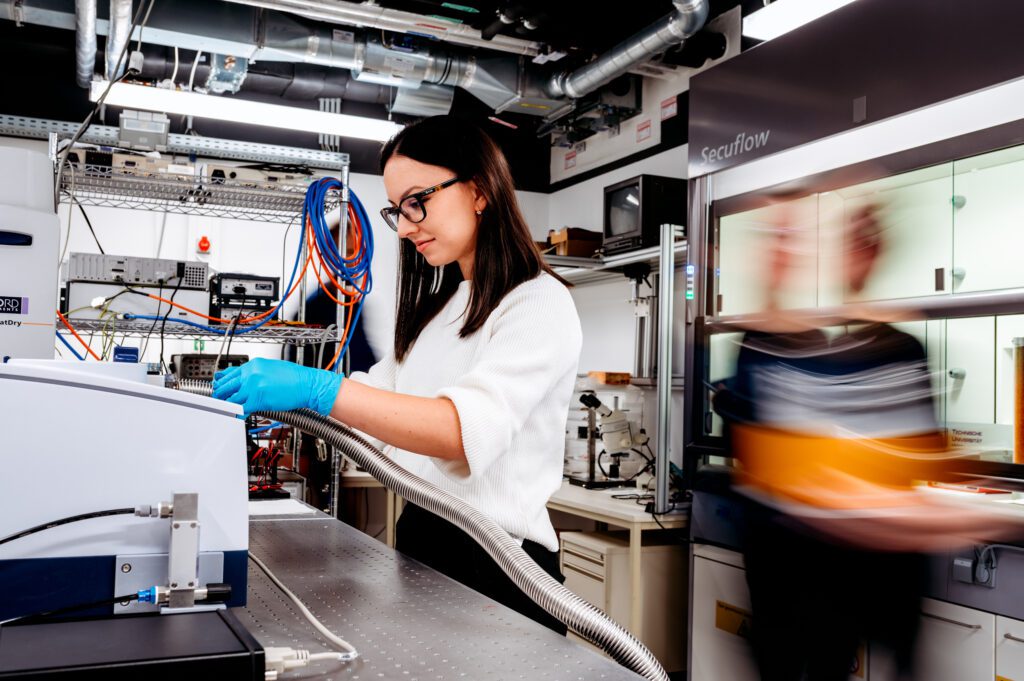
“The original technology was incredibly sensitive, but completely unusable for most scientists,” she recalls. Running it required time-intensive setups, skilled practical expertise and a patience for fragile systems.
Turning a delicate lab research instrument into a reliable handy product requires work alien to many academic scientists: electronics to redesign, software to rewrite, hardware to ruggedise and user interfaces to make it usable by people who just want it to work. After that, regulations and certifications to sign off, or no one gets to play.
“This isn’t research anymore,” Josiane says. “It’s development. And there’s a big funding gap there.” It was filled by a €2.2m EIC Transition grant that helps research concepts bridge the territory familiar to deep-tech ventures: too advanced for basic research funding, but not mature enough for large-scale commercial investment.
Particle pollution
Why look for such small things at all? Air pollution is one of the biggest environmental threats to human health. In the EU 240,000 deaths per year were attributed to fine particulate matter according to 2024 European Environment Agency (EEA) data.
Although trending down, air pollution continues to be the top environmental health risk to Europeans, especially in cities and urban areas. The vast majority (98%) of Europeans live in areas with fine Particulate Matter (PM 2.5µm) concentrations exceeding WHO guidelines, resulting in increased rates of stroke, cardiovascular disease, asthma, lung cancer, chronic illness and preventable deaths.
These ultrafine airborne nanoparticles, less that 25.000 of a centimetre in diameter, are too small to rebreathe and go deep into the lungs, causing constant damage. Below PM 1µm there are no regulations as the particles are so hard to detect – what’s out there?
Early NEMILIES project prototypes only just met the “make measurable what is not so…” bar – they worked but Josiane admits they were “barely usable”. User feedback often meant going back to the drawing board and starting again. But given enough time, any hands-on engineer will tell you this is where the magic happens.
Pilot users given early instruments were encouraged to push them to the limits in real conditions, generating feedback that shaped the next design cycle. Over time, the detector evolved beyond its lab-bound ancestor: a compact device hiding its complexity behind a simple interface. At Technology Readiness Level 6–7 (system prototype demonstration in a relevant environment), its potential was no longer theoretical.
When Deep Tech Leaves the Lab
The first prototype was acquired by the Extreme Environments Research Laboratory (EERL) at EPFL in Switzerland, where Assistant Professor Julia Schmale is studying aerosols in Arctic and Antarctic regions to understand their impact on climate dynamics. Julia Schmale had been a pilot user throughout the NEMILIES project, providing invaluable feedback and support throughout the process, and ultimately contributing significantly to shaping the outcome.
The high sensitivity and portability of the new sensors enabled deployment on tethered balloons in the Arctic and Antarctica to explore the vertical distribution of aerosols and their chemical composition, opening up new research possibilities. “Exactly what we hoped for,” Josiane says. “Seeing a scientist use this tool to learn something new about the real world – that’s the point.”
Since then, additional units have been sold internationally, and Invisible Light Labs, the spin-out company formed to commercialise the technology, has signed a partnership with a major scientific instrument manufacturer to support global distribution. Their work combining nanoelectromechanical sensing with Fourier-transform infrared technology has been rightly recognised by winning Innovation of the Year 2024 from The Analytical Scientist. The outcome was EMILIE, the world’s first Fourier-transform infrared (FTIR) spectroscopy instrument based on nanoelectromechanical systems (NEMS) technology.
But the story is not only about technology. Scaling a company also means scaling responsibility. Managing a growing, multidisciplinary team required new approaches to leadership and culture.
For Josiane, it also meant balancing the demands of a growing company with personal commitments, including young children and an MBA completed alongside the project. “There’s a lot of pressure,” she reflects. “But there’s also a huge sense of pride.”
For years, nanomechanics promised extraordinary sensitivity, but little accessibility. Now, with practical picogram-level sensitivity in the mid-to-far IR range, that promise has begun to materialise. In the process, some of the most elusive aspects of the world around us are becoming, finally, measurable.
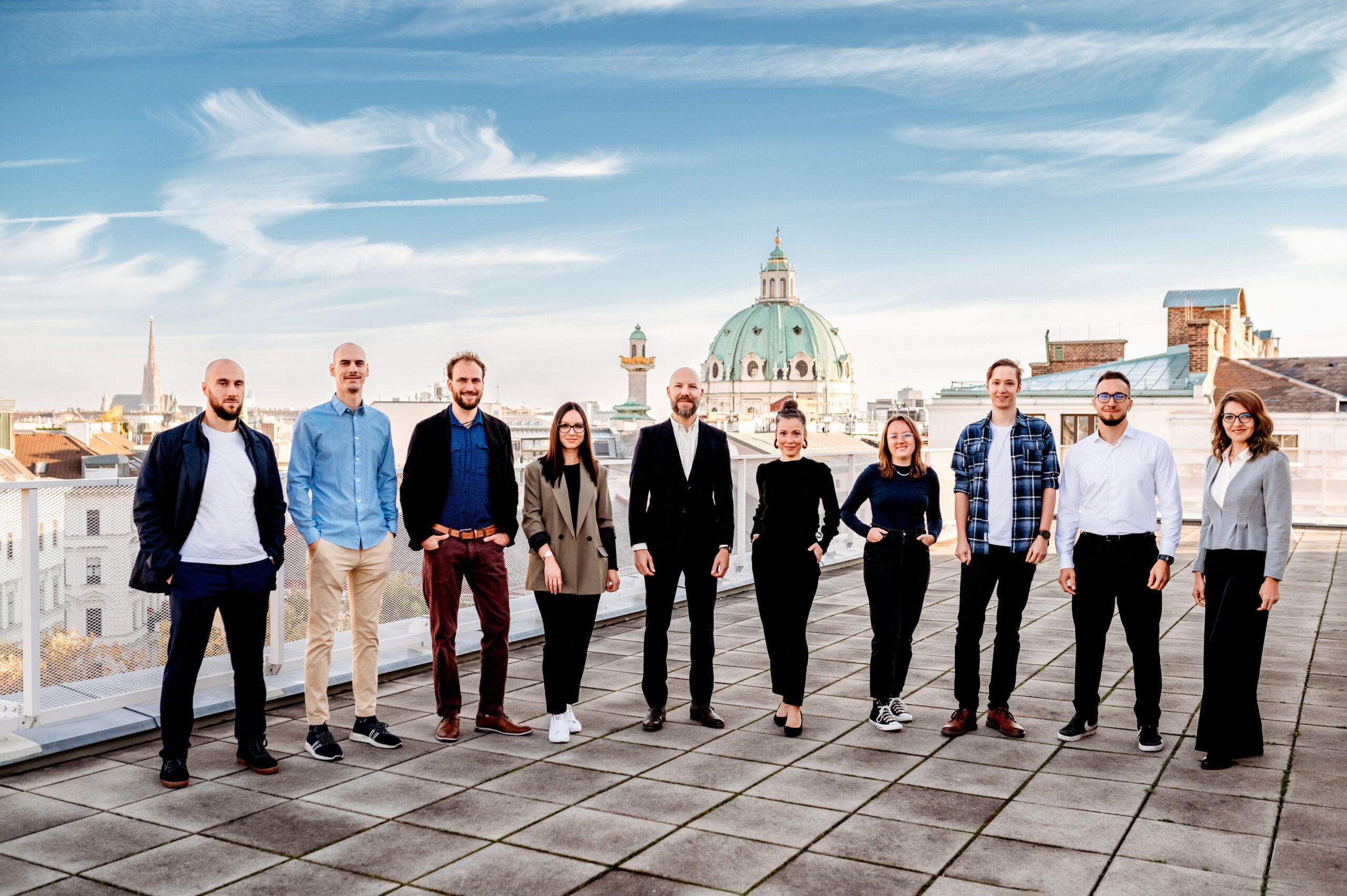
Photo credits:
Cover: Photo by Rick Rothenberg on Unsplash
Others: @Romana Maalouf photography
