

FROM IGNORED SYMPTOMS TO REAL SOLUTIONS FOR WOMEN’S HEALTH – THE MISSION OF ENDOSOLVE
For years, conversations around hormonal and pelvic health have been overshadowed by stigma, silence, and misunderstanding. Millions of women have endured pain without answers, suffering in silence. But change is coming. EndoSolve, a pioneering EU project, is redefining how we understand and diagnose pelvic conditions early, offering women clarity, validation, and hope. Rooted in empathy and driven by innovation, the project’s journey shows that science can be both deeply human and profoundly transformative.

Siobhan Kelleher, founder and CEO of OnaWave Medical, leads EndoSolve, an European Innovation Council-funded innovation developing a digital biomarker-based platform to identify pelvic conditions such as endometriosis and subfertility. Her work sits at the intersection of biomedical engineering, reproductive physiology, and digital signal analytics. Yet, beyond the science, her motivation lies in bringing hormonal health to the centre of precision medicine, an area that has been long neglected.
“By understanding the body’s natural signals, we can change the way we diagnose, treat, and empower people throughout their lives.”
EndoSolve wasn’t the first project. It’s the result of years of exploration, failure, and rediscovery in women’s health. Siobhan and her early collaborator, Sinéad Hughes, began with a different focus, improving fetal monitoring using bioelectrical signals to enhance outcomes for both mothers and babies. The results were promising, but institutional and commercial barriers made progress impossible. “We could have stopped there, but we pivoted to secure funding to bring the concept closer to practice.” Siobhan recalls,
“We knew the problem was bigger. Women’s health needed more than one solution, it needed a revolution.”
Next, they developed a keyhole surgery technology designed to improve retrieval of intact tissue specimens. The idea worked in theory, but it wasn’t technically feasible. Still, rather than turn away, they doubled down on their commitment to women’s health, exploring areas such as postpartum depression, undiagnosed PCOS, recurrent miscarriage, and subfertility. Among all these conditions, one stood out: endometriosis.
“Women were literally knocking on doors for years, searching for answers,” Siobhan says. “They didn’t want sympathy, they wanted evidence, something that proved it wasn’t all in their heads.”
This became the seed of EndoSolve. What began as a search for one biomarker soon revealed something much larger: a platform that could map hormonal rhythms across the entire lifespan, both women and men, in conditions like premature ovarian failure, irregular bleeding, miscarriage and endometriosis. “Pelvic health isn’t a women’s issue — it’s a human issue,” Siobhan emphasises. “That realisation shaped our mission: to revolutionise pelvic and hormonal healthcare using the biological intelligence of the body itself”.
From the beginning, EndoSolve was built on collaboration. “It started with friends, researchers, clinicians, and patients who believed healthcare could be fairer and more precise,” she says. Sinéad Hughes’ early dedication helped turn an idea into tangible evidence, while the project’s next phase was strengthened by a growing team. When the EIC Transition funding was secured, John Hegarty joined as Chief Operating Officer, bringing decades of leadership from Baxter Healthcare, and Hari Om Aggrawal came on board as CTO, turning down a professorship to dedicate himself fully to the technology. “Their decision to join was a turning point,” Siobhan reflects. “It gave us both technical depth and the confidence to think bigger.”
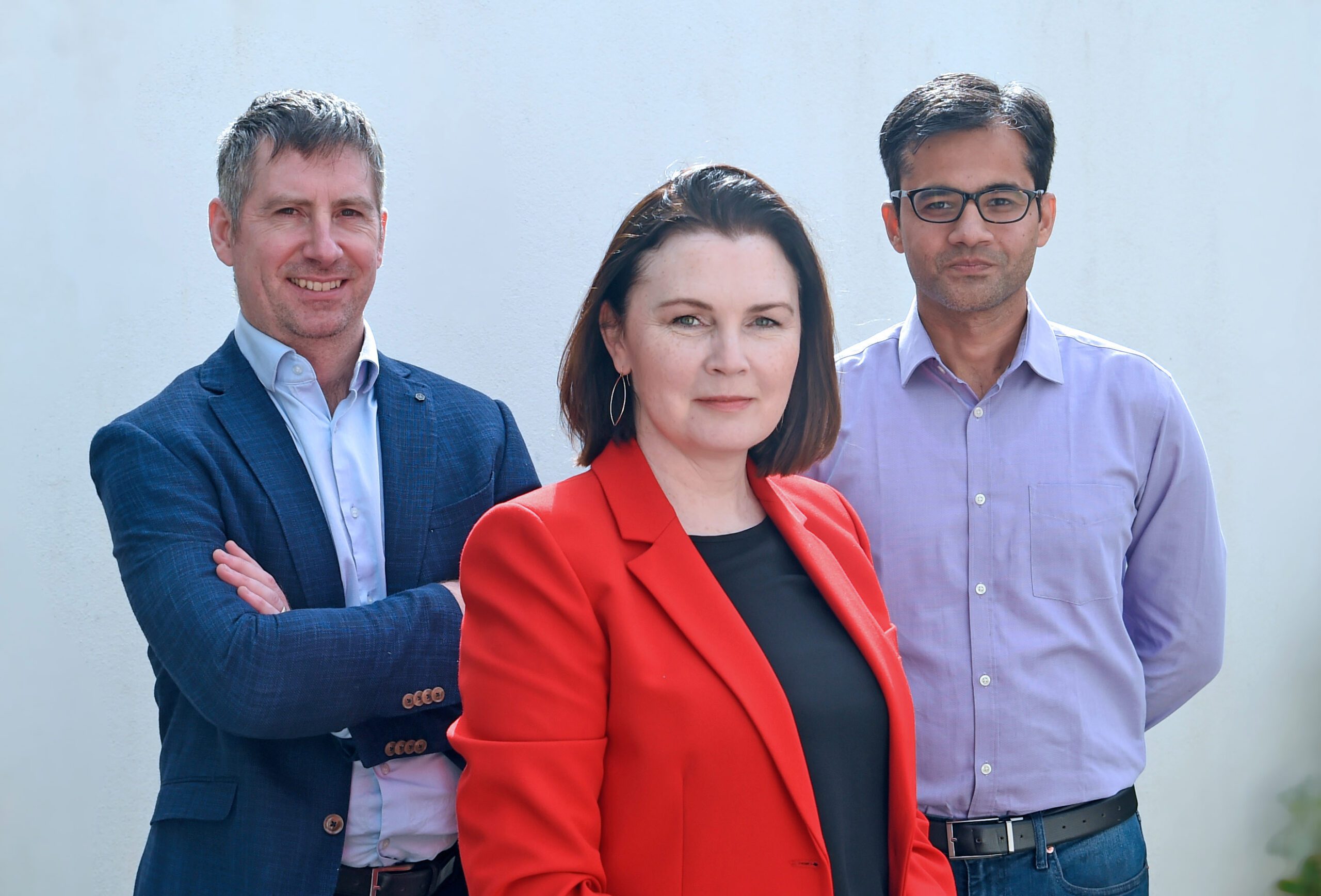
Siobhán Kelleher from Onawave Medical, with colleagues John Hegarty and Hari Om Aggrawal.
Photo Conor McKeown
Patient and public advisor Kathleen M. King has also been with the project from the start, ensuring that every step of EndoSolve reflects real patient experiences. “Kathleen reminds us why we’re doing this,” Siobhan says. “Ensuring that every step of EndoSolve reflects the lived experiences of those it seeks to serve.”
The path hasn’t been easy. Finding a lab willing to test their technology in an animal model of endometriosis proved impossible, so they built their own. “We were the first in the university to use female rats,” Siobhan explains. “Before us, all studies used males, which made no sense when studying a female-specific condition.” Managing the animals’ four-day hormonal cycle was a challenge, but it produced groundbreaking results. Unfortunately, just as success seemed near, disaster struck. Environmental noise interfered with their data, and during lockdown, their samples were lost. “It was heartbreaking,” she admits.
Then, when a human volunteer study was ready to begin, COVID-19 shut the university down. Soon after, Sinéad left the project. “For a moment, it felt like everything had fallen apart,” Siobhan remembers. But rather than giving up, she reached out to Kathleen and the patient advisory group with an unconventional idea: “If we post devices to your homes, would you record and share your data?”
And they did it. From homes across Ireland, women — and men — recorded biosignals and shared their experiences. “Their trust transformed everything,” Siobhan says. “It wasn’t just data; it was solidarity.” That collective effort became the proof of concept that secured their EIC Transition grant.
“We owe a profound debt of gratitude to these volunteers — their trust and generosity transformed EndoSolve from a scientific concept into a collective achievement,” she adds with quiet pride.
EndoSolve’s ambition is bold: to cut the diagnostic time for endometriosis from years to days using a combination of wearable sensors, a smartphone app, and machine learning. Today, individuals with endometriosis often wait up to a decade for a proper diagnosis — a delay caused by symptom dismissal, misdiagnosis, and lack of access to specialists. By offering a non-invasive, at-home adjunct test, EndoSolve aims to close that gap. “We want to make early and accurate diagnosis a reality,” Siobhan says.
“No one should have to live in pain, waiting for answers.”
The vision doesn’t stop there. In the long term, the team hopes to create a digital pelvic health ecosystem, an integrated model of care that combines reproductive, hormonal, and chronic pain management. “Our goal is to make hormonal health the cornerstone of precision medicine,” Siobhan explains. “It’s not just about disease – it’s about lifelong wellbeing.”
Cover picture by Align Towards Spine on Unsplash
