


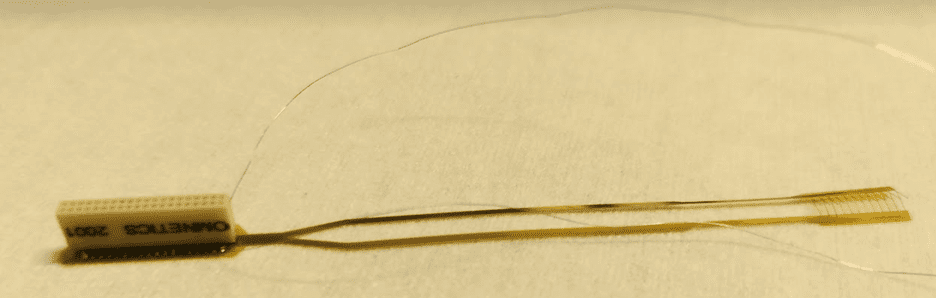
In a lab tucked inside KU Leuven’s neuroscience department near Brussels, a thin filament, barely thicker than a human hair, shimmers under the microscope. To neuroscientist Peter Janssen, this microelectrode is literally a visionary mission.
“The goal of this project is to make the blind see again with artificial vision, enough to hopefully see contours, to see where there’s a door, where is a person,”
Peter Janssen leads HYPERSTIM, a European research project that bravely asks one of medicine’s oldest questions: can we make the blind see again? His answer lies not in the damaged eye, but in the living, listening tissue behind it. “Most causes of blindness destroy the retina,” Peter says. “But the brain that receives those signals is usually perfectly intact. So why not go straight to the source of vision, the cortex itself?”
The HYPERSTIM team’s approach is to implant thousands of ultra-flexible microelectrodes directly into the brain’s visual cortex. Each electrode delivers tiny electrical pulses that mimic neural activity patterns created when light hits the retina in normal sight. Feed those pulses with data from a camera to shape them, and an artificial vision begins to take shape in the brain: outlines, objects, perhaps the resolution to make out faces.
Lighting the way
It sounds like science fiction, but the concept has precedent from experiments back in the 1970s demonstrated that stimulating the visual cortex could make people see perceptible flashes of light called phosphenes. The problem then was practical: larger metal pins damaged tissue, signals were blurred, and less reliable implants failed. Half a century later, HYPERSTIM’s microelectrodes are softer, as thin as hair, and engineered to move organically with the brain.
The microelectrodes are born of a collaboration years in the making. Peter’s colleague at KU Leuven, engineer Frederik Ceyssens, came to him with this new technology, better than anything that existed at the time, that had been successfully tested in rats, asking for practical projects to take it to the next level. They are now produced by a Leuven-based start-up called Revision Implant (of which Frederik is co-founder and CEO), populated by engineers turned entrepreneurs, who have used thin-film technology to further develop the technology at the nerve centre of the HYPERSTIM project.
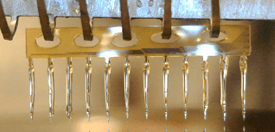
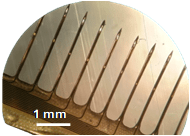
“The advantage of very thin flexible electrodes is that you can implant thousands of them in the brain,” says Peter. “The brain well tolerates ours, and you need thousands of electrode contacts to get a useful image.”
The HYPERSTIM consortium is a small ecosystem of four partners, each withthe necessary expertise to turn technology into a patient benefit. At the Research Centre for Natural Sciences in Budapest, researchers image calcium signals in mouse brains to see how neurons react to stimulation. At the Pompeu Fabra University of Barcelona, computational neuroscientist Gustavo Deco builds models to predict those patterns at a scale relevant to human vision. Back in Leuven, Peter oversees the animal experiments on monkeys to bridge the gap between neurophysical theory and the biological reality that must take place before human clinical trials.
The right support makes the impossible possible.
For all the optimism and vision, the project has had to overcome serious practical problems. The hardest part turned out to be the deft art of inserting the microelectrodes in the soft and springy texture of the human brain. Early prototypes crumpled before they could pierce the surface without damaging tissue. “We spent two years finding the optimal procedure to insert these electrodes into the brain, and that technique is now patented,” Peter recalls. “But there are always day-to-day problems related to invasive procedures. We have to be careful that there is no infection, no bleeding in the brain.”
That breakthrough only came after funding support in the form of a 2022 European Innovation Council (EIC) Pathfinder grant, a funding mechanism designed to take forward ambitious deep tech projects with high risk, but that could create new markets.
“The EIC support is really crucial, because in these first years nobody will invest in your company because you don’t have enough data yet. The EIC is very important to bridge these years before you get to the big investors.”
That fait and seed funding support has grown and developed into new opportunities: Revision Implant has grown to seven employees, secured investment from Europe’s leading microelectronics research centre IMEC, and attracted collaborations with Cochlear, the company that helped millions of deaf people hear. A final investment from a Silicon Valley venture capital company paints a picture that, while optimistic, also has significant challenges ahead.
Peter says that to get to the final product, they need about 20 times more money than the EIC provides. And the research path is rarely straight. An upgraded MRI scanner is no longer aligned with the previous equipment, slowing the project by a full year. Administrative update reports to funders and investors stretch to over a hundred pages. For Peter, there just aren’t enough hours in the day.
But the HYPSERSTIM team, the dream of helping a blind person restore a degree of vision to navigate a room using their technology, outweighs every bureaucratic frustration. Each test and incremental improvement turns the shimmer under the microscope into something more profound and fundamentally useful: a connection between light, perception, and improved human experience.
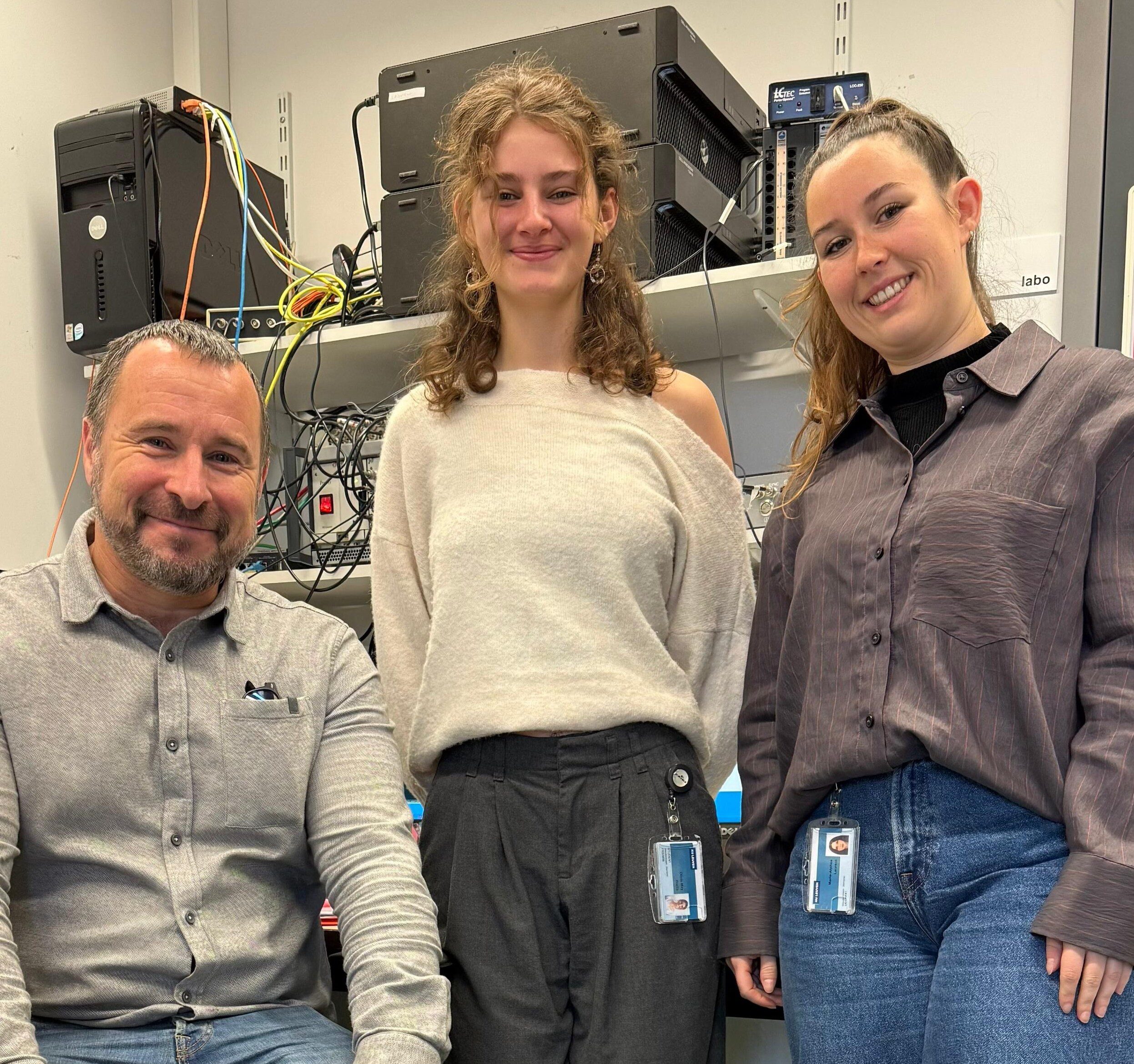
“What is particularly motivating is the long-term goal of having blind people walking around with a device that we developed, that we tested, that we optimised,” Peter explains. “That would be our man on the moon moment. An example of how decades of basic research can finally lead to therapies for patients.”
Photo by Luke Jones on Unsplash
